

 Lingamma Rays, 2020
 Studio
Manifesto · Two registers · Seven frames
Curatorial register. For wall texts, catalogue essays, institutional applications, and curators who need to write about the work without reading 10,000 words first.
Ole Ukena's practice extends across studio object-making, distributed participatory artworks, spatial commissions, social-form frames, and pedagogical projects, treated as one continuous artistic operation in the tradition of Joseph Beuys's erweiterter Kunstbegriff — the expanded concept of art. Trained at the Universität der Künste Berlin (2003–2009) as Meisterschüler of Lothar Baumgarten; he also attended, in parallel, Katharina Sieverding's Visual Culture Studies class, Hito Steyerl's class (guest professor 2007/08) and Daniel Richter's class, working across teachers rather than staying with one and has worked outside conventional gallery representation while sustaining institutional placements (Centre Pompidou Paris, 2011; Palais de Tokyo; Grand Palais Paris Photo, 2013; Genezarethkirche Berlin permanent commission, 2022; Zona Maco Mexico City, 2026).
Two registers
The practice operates in two studio registers held in parallel for two decades.
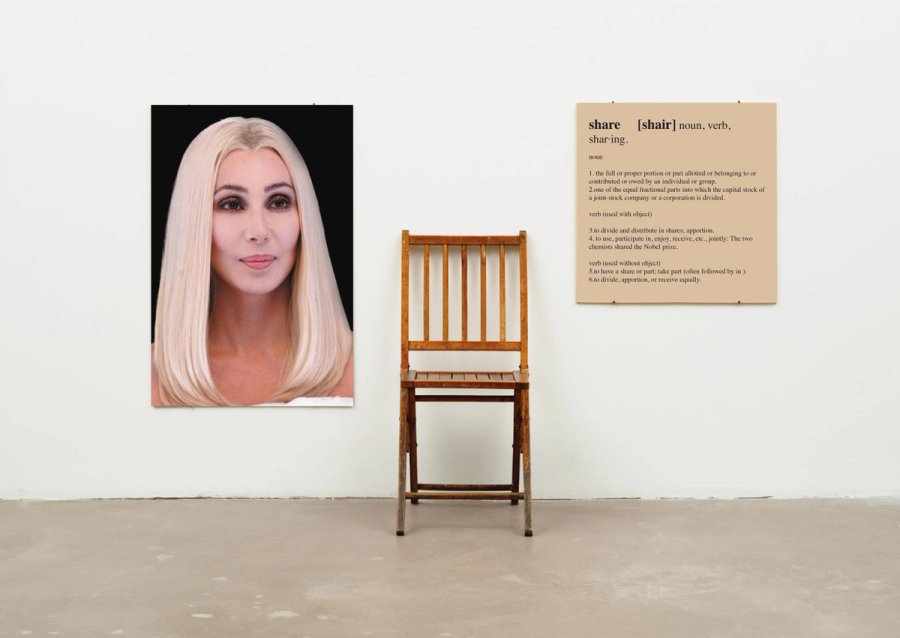
The first is conceptual, in the diptych branch of the post-1965 conceptual tradition associated with Marcel Broodthaers, Mona Hatoum, Felix Gonzalez-Torres, and Glenn Ligon. Works compress opposed terms into single material objects: PEACE (toy soldiers, the material of war forming the symbol of peace as diptych), TRUST (nails oriented one way to threaten and rotated 180° to support and to spell the word), RAINBOW (paradise rendered in barbed wire), CHER, CHAIR, SHARE (the homophone as collapse of Kosuth's semiotic triangle), LOOK AT YOUR / SELF (the viewer's reflection completing the absent text), THE ONE AND ONLY TRUTH (an absolute claim physically demonstrating its own multiplicity). The early conceptual operation returns at full operational maturity in CINIS (2026), a time-bound wedding artwork structured as a legal contract with a programmed seven-year fade.
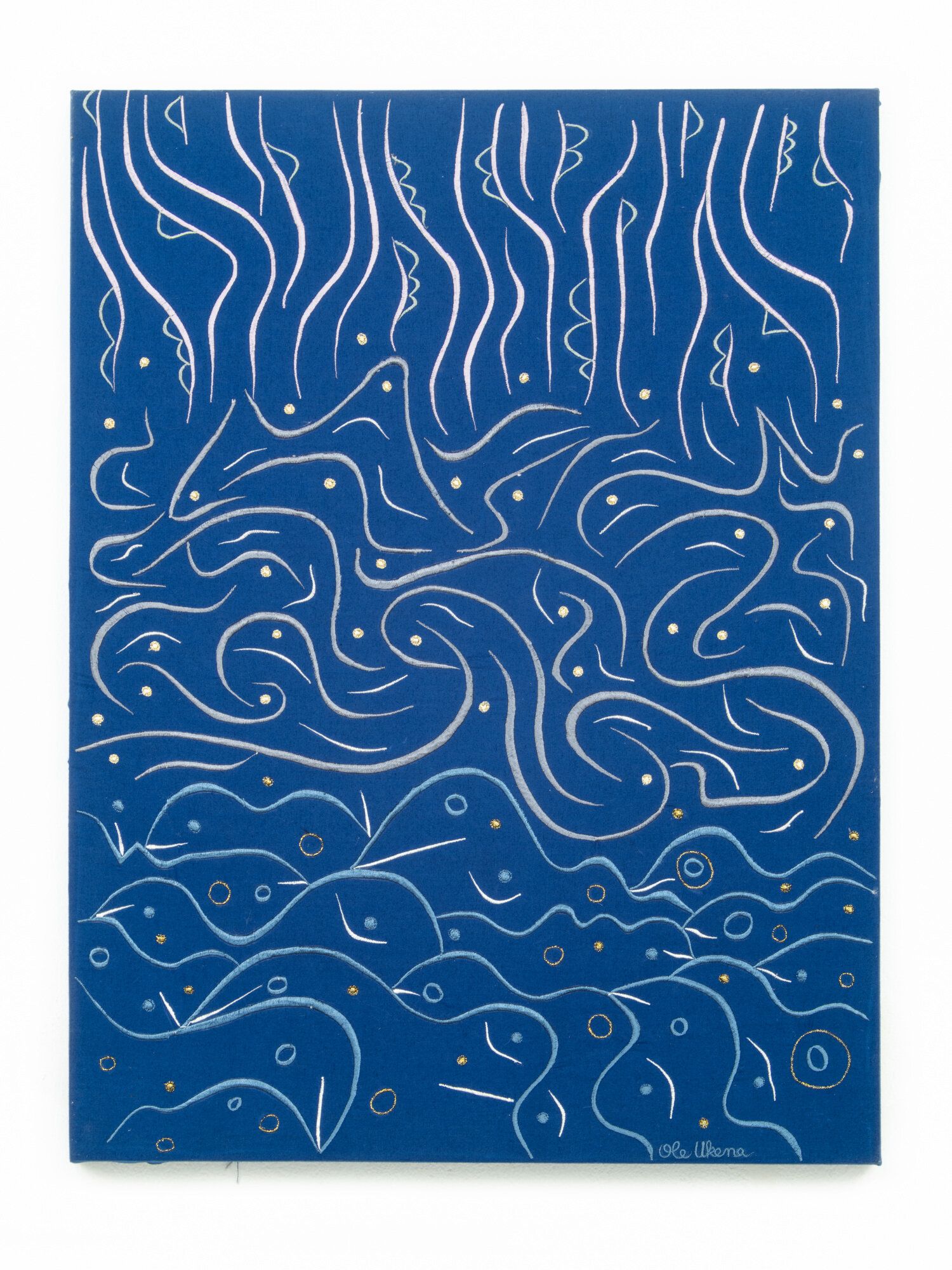
The second register is intuitive and material. Since 2017, Ukena has worked at scale with a sustained studio of artisans in Ubud, Bali, producing large-format embroidered textile paintings (3–3.5 m height, 600–800 hours per work) executed under a stated methodology of chalk-drawn line, flow-state constraint, and series-form feedback loops between the artist and the team. The Multiverse series (2020–) extends this into mandalic structures of attempted identical eight-fold repetition: the human hand's inability to repeat exactly is the registered subject of the work. The work surfaces, frequently on reflective fabric, refuse fixed perception, shifting visibly with light angle, scale, and viewer position.
The inverse-LeWitt position
Beneath the textile register sits a structural innovation that distinguishes the practice within its lineage. Where Sol LeWitt's instruction-and-execution model treats the executing hand as neutral and the outcome as predictable, Ukena's studio configuration is its inverse: chalk-line drawn fast under a rule designed to suspend analytical control, translated by named individuated hands that cannot reproduce the line identically, returning to the artist as new information across material delays that feed the next piece in a series long enough that early returns inform later drawings. This is collective improvisation as compositional method — a form closer in operation to jazz ensemble or Aboriginal Papunya Tula and Spinifex Arts collective painting practice than to conventional Western studio production. The studio team is part of the artwork itself.
Spatial and distributed works
Spatial works (Space Bloom / Weltraumblüte, 2022; Church of Now, 2022; Flowstate, 2021) extend the studio practice into installation, often as residue of larger collaborative festivals that are themselves the work. Distributed participatory works under the UKENA project (2020–) operate as wearable artworks with a seven-layer authorship chain in which the wearer is named co-author by signature inside the garment, with an integrated digital participation layer (lottery, donation to artisan support and education, course access, story contribution) currently in development.
Frames as registered artistic projects
Beneath all studio activity runs a twenty-year frame practice. The frames are registered as artistic projects in the erweiterter Kunstbegriff tradition — not biographical context: each is a constructed condition under which work, the artist's own and others', emerges. Three of them now carry their own websites; this is treated as a category of the practice rather than a deviation from it. Galleries are one venue among several.
It is always what you think it is.
I am not here to tell you what to see, but to create a space where the seeing can be witnessed.
For the long-form argument (the diptych operation across every register, the inverse of LeWitt's instruction-execution model, the frames as erweiterter Kunstbegriff in 2026), see the essay Two Registers, One Hand.
The seven frames
Each frame is a registered artistic project. External links open the frame's own surface.
-
Spielraum
How do you make a space where life happens and money isn’t the point?
A Berlin gallery and platform — the first frame. Founded as a curated space treating exhibition-making itself as an artistic operation rather than a commercial venue.
-
CRE8 Foundation
How does a child, with a real artist, make a work bigger than any one of them?
A foundation for artist support and collective practice. Frames the question of how an artist can construct economic conditions for other artists' work.
Visit → -
AIR — Open Artist Residency
How do you build the place you yourself want to stay?
AIR Ubud: six units, one shared 300m² studio, communal meals, downtown Ubud. AIR Temple: four houses each with own studio in Desa Kenderan — beside a water temple, rice paddies, a river, twelve minutes from Ubud. Two formats, one frame, one website. Built because the answer to "how do you build the place you want to stay?" needed two different answers.
Visit → -
UKENA
How does an artwork move through the world on a body?
A body of wearable conceptual artwork. Each garment carries a seven-layer authorship chain in which the wearer is named co-author by signature inside. Has its own website.
Visit → -
I AM YOU
When music gathers a room, who is the artist?
A music + ritual + gathering frame. Treats the live event as the work — distributed authorship across audience and ensemble.
Visit → -
UNFUCK YOUR CREATIVITY
What is the book about making things I wish someone had handed me at 20?
A pedagogical frame. Books, workshops, and language artifacts that name the obstacles to creative agency.
Visit → -
CINIS
What does a ritual look like when art does the work religion used to do?
A time-bound wedding artwork structured as a legal contract with a programmed seven-year fade. The early conceptual operation at full operational maturity. Has its own website.
Visit →


